
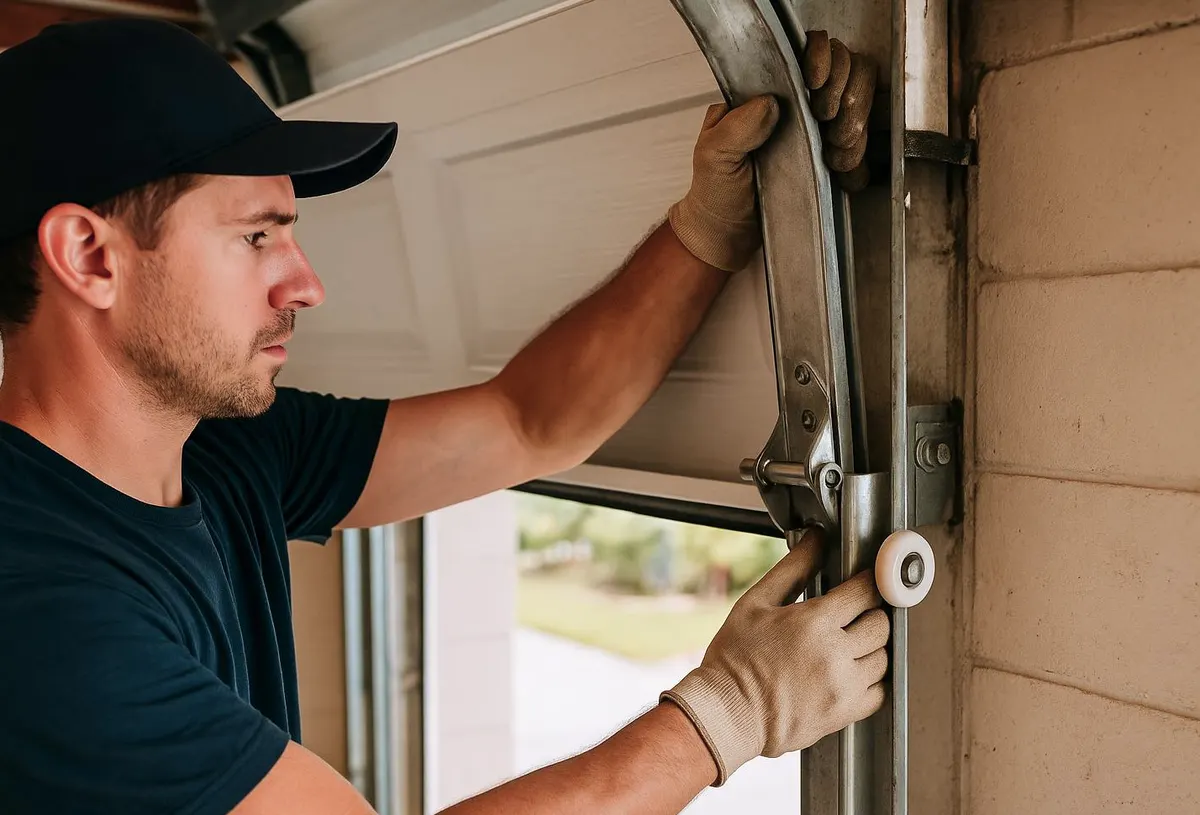
What a Technician Sees on This Kind of Call
The call usually starts the same way: the homeowner presses the remote, the door starts down, and somewhere between a few inches and a foot off the ground it stops and goes right back up. Sometimes it happens every time. Sometimes it only happens at night or after a hard rain. A few callers report something different — the opener motor runs, they can hear it working, but the door never moves downward at all. Both versions point to the same family of problems, and most of them are quick to diagnose once you know where to look.
The Symptoms, Broken Down
- Reverses a few inches down: almost always a safety sensor issue.
- Closes most of the way, then reverses right at the bottom: often a track, roller, or bottom-bracket problem, or a force setting that's slightly off.
- Won't move down at all, motor hums or runs: can be sensors, force settings, or in older systems, a failing circuit board.
- Works from the wall button but not the remote, or vice versa: usually a signal or wiring issue rather than a mechanical one.
A technician works through these from the simplest, most common cause to the least common, because that's the fastest way to get a homeowner's door working again without replacing parts that aren't actually broken.
1. Safety Sensors (Checked First, Nearly Every Time)
Every modern opener has two photo-eye sensors mounted a few inches off the floor on either side of the door. If anything breaks that invisible beam between them, the opener treats it as an obstruction and reverses the door — that's the system working correctly, just reacting to something.
In this part of Virginia, humid summers leave condensation on the sensor lenses, and after heavy rain, moisture can creep into the sensor housing or wiring connections. Dust, spiderwebs, or a stray leaf blown in during a coastal storm will do the same thing. The fix is usually cleaning the lenses with a soft cloth and checking that both sensors are aligned to the same height — a bump from a parked car, a bike, or stored items can knock one out of position just enough to cause intermittent reversing.
2. Sensor Wiring and Connections
If cleaning and realignment don't solve it, the next check is the wiring. Older homes often have sensor wire that's been nicked, pinched, or chewed by rodents over the years, and corrosion from humidity can creep into the connection points at the sensor or the opener unit. A technician will test continuity and replace damaged wire runs rather than the sensors themselves, since the sensors are often fine.
3. Track Alignment and Obstructions
If the door reverses specifically near the bottom of its travel, the track is next. Tracks can shift slightly over time, especially in older houses where the framing has settled, or after a storm rattles the door hard enough to nudge the mounting brackets. In winter, ice buildup at the base of the track — common after freezing rain — can physically block the door's path and trigger a reversal that looks electrical but isn't. The fix ranges from simply clearing debris or ice to re-tightening and realigning bent track sections.
Rollers and Hinges
Worn or rusted rollers create drag that the opener may interpret as resistance, especially on older doors that have gone years without lubrication. Humidity accelerates this wear. Replacing rollers is a straightforward repair and often gets lumped into the same visit as a track adjustment.
4. Force and Limit Settings
Every opener has adjustable force settings that tell it how much resistance to push through before assuming something's wrong and reversing. These settings can drift over time, and temperature swings between humid summer days and icy winter nights cause enough expansion and contraction in the door and hardware that force settings calibrated in one season may need a small adjustment in another. Recalibrating this is quick, but it's also easy to set incorrectly, which is why it's usually checked by someone familiar with the specific opener model.
5. Spring Tension
If the door feels unusually heavy when lifted manually, or if force settings have been adjusted repeatedly without lasting results, worn torsion or extension springs are often the real cause. A weak spring means the opener's motor has to work harder to lift the door, and the opener's safety system reads that extra strain as an obstruction and reverses it — even though nothing is actually in the way. This is common in the mix of older and newer housing across the area, since torsion springs have a working lifespan measured in open-close cycles and eventually need replacement regardless of how well they've been maintained. Spring repair isn't a DIY job; the springs are under heavy tension and require the correct equipment to replace safely.
6. Opener Logic Board (Last on the List)
If sensors, wiring, track, force settings, and springs all check out, the opener's circuit board itself may be failing to interpret signals correctly. This is less common but does happen, especially in older units nearing the end of their service life. Board replacement or a full opener replacement is usually the recommendation at this point, since repairing an aging board often costs close to swapping in a new, more reliable opener.
When to Call Newport News Garage Door
If you've cleaned the sensors and the door still won't close, or if it's been getting progressively heavier to lift, it's worth having it looked at before the problem gets worse or a part fails unexpectedly. Our Garage Door Opener Repair & Installation service covers everything from sensor alignment and wiring repair to force recalibration, and our Spring Replacement service handles worn torsion or extension springs safely, with the right tools for the tension involved. We'll test the door's balance, check the track, and tell you plainly what's wrong and what it takes to fix it.
If your garage door is reversing, stalling, or refusing to close, call Newport News Garage Door today and we'll get it sorted out before winter weather makes it worse.